Key Moments
Delegate the next step, not just ask questions
Treat agents as workers: give them an objective, connect the tools they need, and let them research/execute multiple steps until human approval is required.Connect before you automate (do an agent-readiness audit)
List recurring tasks, map where the information lives, clean up/centralize your data, and start with low-risk workflows like research, monitoring, drafting, and retrieval.Use agents to cut cognitive load via inbox-style workflows
Let AI review, reconstruct, and prepare outputs from communication and correspondence so founders spend less time searching and remembering and more time judging.Redesign human work: build a command centre and invest saved capacity
When agents handle more tasks, use the freed bandwidth for customer experience, product development, and higher-level judgement—rather than expecting simple headcount reduction.Watch the interview · CNC3 Morning Brew
For most of the last two years, I have been cautious about recommending AI agents to the average business.
I could see the potential, but I also understood the reality of the businesses I work with across the Caribbean. Many companies are still trying to get the fundamentals right: modern websites, customer relationship management systems, digital payments, analytics, structured data, cloud storage, cybersecurity and basic automation.
Against that backdrop, telling a business owner to install an autonomous AI agent, configure models, connect APIs, manage credentials and allow software to begin operating on their behalf felt premature.
The technology was powerful. The experience was not yet practical enough.
That has changed.
My shift in thinking did not come from one dramatic product demonstration. It came from several things happening at the same time: AI agents becoming easier to deploy, ChatGPT gaining deeper connections to the tools I already use, computer-use systems becoming capable of operating software on my behalf, scheduled monitoring becoming more useful, and the infrastructure for agentic commerce beginning to emerge.
Then I saw Grok Bot.
That was the moment when I thought: businesses need to start paying attention.
Grok Bot changed the accessibility equation
AI agents are not new. Platforms such as OpenClaw and Hermes have already demonstrated what becomes possible when an AI system can use tools, retain context, execute multiple steps and continue working toward an objective.
But there is a difference between something being technically possible and something being accessible to the average business owner.
OpenClaw and Hermes remain compelling tools, particularly for technical users who want significant control over how their agents are configured. That flexibility is valuable, but it also means dealing with installation, model providers, credentials, terminals, integrations and other technical decisions.
Grok Bot moved much of that complexity further into the background.
The proposition becomes considerably easier to understand: create an AI worker, tell it what its job is in normal language, provide access to the applications or websites it needs, establish its boundaries and allow it to work.
The important change is not merely that AI became more intelligent.
It became easier to delegate to.
For a business owner, the practical benefit is being able to hand over work and get a result back.
For years, most people’s relationship with generative AI was based on conversation. You asked ChatGPT a question and it produced an answer. Then we moved into the copilot phase, where AI helped us draft emails, create presentations, analyse documents, write code or develop strategies.
Agents introduce another stage.
Chatbots answer.
Copilots assist.
Agents act.
They can be given an objective rather than a single prompt. They can research, monitor, navigate software, gather information, complete multiple steps and return when human judgement or approval is required.
That changes the business conversation from, “What can AI tell me?” to, “What work can I start delegating?”
My business has quietly become a command centre
I began understanding the significance of this through my own business.
Over the last few months, I have connected ChatGPT to an increasing number of the platforms that already run different parts of my operation.
Gmail contains communication.
Google Calendar contains my time and appointments.
Google Drive contains documents and files.
HubSpot contains customer and relationship data.
PayPal represents part of the financial layer of the business.
Once AI can securely interact with those systems, the relationship changes.
I am no longer simply opening ChatGPT to have a conversation about my business. I can increasingly use it as an intelligent interface into the business itself.
That is a much bigger idea.
For the last 20 years, digital transformation has largely meant adding more software. Businesses acquired an email platform, CRM, payment system, calendar, cloud storage, accounting platform, analytics software, project management software and perhaps several marketing tools.
Every new platform solved a problem but also created another dashboard that somebody had to learn and manage.
Agentic AI begins to invert that relationship.
Instead of me constantly moving between software, the AI can increasingly move between software for me.
Natural language begins to become the interface.
I can speak into my phone and ask for an outcome.
That is why I have started thinking of ChatGPT less as another application and more as a command centre.
The inbox example changed everything for me
Email has become one of the clearest demonstrations.
I have reached a point of communication fatigue.
We now have WhatsApp, Instagram direct messages, Facebook Messenger, LinkedIn messages, Telegram, email, SMS and countless other ways for people to contact us instantly.
For business, I increasingly push people toward email because I want one structured communication pathway.
But that still left me with the problem of managing the inbox.
I had even considered hiring a virtual assistant to help manage it. The problem was that I did not particularly like the idea of another person having unrestricted access to years of personal and business email.
AI changed that equation.
Now ChatGPT can help me search, analyse and understand the inbox without me manually reading through everything myself.
I recently had an issue involving a company that had been late paying me. Normally, escalating the matter would have required me to search through months of correspondence, locate different email threads, reconstruct what had happened, confirm dates, review files and then write a detailed account to someone more senior in the organisation.
Instead, I gave ChatGPT a voice instruction.
It reviewed the relevant correspondence, reconstructed the timeline, identified promises and follow-ups, incorporated the supporting context and helped me prepare a complete escalation.
I effectively talked to my business and asked it to tell me what happened.
That entire process took minutes.
The most important benefit was not simply the time saved.
It was the reduction in cognitive load.
Entrepreneurs carry enormous numbers of unfinished loops in their heads: Who owes me money? Did that client respond? When did they promise to send the document? Where is that contract? Did we confirm Thursday or Friday? When do I need to follow up?
If AI can absorb some of the remembering, searching, monitoring and reconstructing, it gives the business owner back something more valuable than hours.
It gives back mental bandwidth.
Monitoring can become delegated intelligence
Another example came from something completely unrelated to work.
I have been researching my next smartphone purchase and comparing different upcoming devices. One model had a promotion ending before another model’s global launch, which created a decision problem.
Instead of manually searching every day for leaks, announcements, pricing and launch information, I set up monitoring.
The important part was that I was not simply asking AI to send me links.
It understood the decision I was trying to make.
It knew the alternatives, the deadlines, what information I already had and what kind of development would materially change my decision.
When something meaningful changed, it could bring the update back with context.
That personal experiment immediately made me think about business applications.
What if a company did the same thing with competitors?
An agent could continuously monitor changes in pricing, products, campaigns, websites, customer sentiment, industry developments or regulations and only escalate developments that mattered.
That is not just automation.
That is delegated market intelligence.
Agents can also operate software
Then there is execution.
I manage my own online academy, so I understand how to build and configure learning platforms. Recently, I was hired to build a Thinkific academy for another organisation.
I knew what the finished platform needed to look like. I understood the client brief. I had their branding, logos, content and other assets.
Traditionally, I would have spent several hours manually building the platform.
Instead, I gave ChatGPT the context and allowed its computer-use capabilities to operate Thinkific under my supervision.
It built the platform.
It also handled technical configuration around connecting the custom domain, something I had previously needed outside help to complete on my own academy.
I still needed my experience to direct the work and judge the result, even when I was not making every click.
I understood the objective.
I understood the client’s business.
I could judge whether the result was correct.
AI performed much of the mechanical execution.
My role moved further up the value chain.
That is the part of the agent conversation businesses should be paying close attention to.
A job is a collection of tasks
We keep talking about whether AI will take jobs, but a job is not one indivisible thing.
A job is a bundle of tasks.
A marketing coordinator might research competitors, prepare reports, schedule content, update spreadsheets, respond to routine messages, brief designers, analyse campaign data and attend meetings.
Some of those activities may become highly agent-friendly.
Others depend much more heavily on judgement, relationships, creativity, cultural understanding, leadership or accountability.
If an agent can perform five of the 20 tasks that currently make up someone’s job, the entire position does not necessarily disappear.
The composition of the job changes.
That creates a much more interesting management question:
What do we do with the capacity we just created?
One answer is cost reduction.
Some companies will undoubtedly use AI that way, and some roles will disappear where technology can handle a substantial portion of the work.
But that is not the only possible outcome.
A business could redirect the capacity into customer experience, product development, expansion, research or entirely new capabilities.
Perhaps the organisation can finally hire a cybersecurity specialist.
Perhaps it can add a data analyst.
Perhaps it needs an AI operations professional, ecommerce specialist or another role that was not financially viable before.
AI does not only give businesses the ability to reduce labour.
It gives them the ability to redesign where human talent is used.
Tasks are changing, so skillsets must change
There is an uncomfortable implication for workers.
If the majority of your professional value comes from tasks that can increasingly be automated, then your position becomes more vulnerable.
The answer cannot simply be resistance.
Employees need to look at their own jobs the same way companies should.
Which parts of my work are repetitive?
Which parts require genuine expertise?
Which activities can AI accelerate?
What new capabilities could I develop?
How do I become the person directing these systems rather than competing with their cheapest capabilities?
The people who continually upgrade their skills will be positioned very differently from those who expect the task mix of their job to remain unchanged.
Every employee may eventually have agents available to them in the same way employees today have access to email, spreadsheets or cloud software.
The question becomes how effectively they use them.
The one-person company becomes much more powerful
This is particularly interesting to me because I have spent years operating as a solopreneur.
People have repeatedly told me that I eventually need to hire a team.
That advice was based on a reasonable historical assumption: one person only has so many hours.
Eventually, growth requires more labour.
Agentic AI begins to change that calculation.
A one-person company no longer necessarily means one worker.
One human founder could increasingly coordinate multiple forms of digital labour: a research agent, administrative agent, monitoring agent, content-production agent, CRM agent or website agent.
That does not make the founder infinitely scalable. Human judgement, relationships, quality control and responsibility still matter.
But the productive ceiling is different.
This is already becoming visible internationally. In China, more than 7 million new one-person companies were established in 2025, up roughly 42% from 2024, according to state-media figures cited by The Wall Street Journal’s report on China’s solo entrepreneurs.
Seven million new companies in a single year. That is a scale of solo entrepreneurship that deserves serious attention.
That figure covers businesses across sectors, not seven million AI startups. It does not tell us how many use AI agents, and AI alone cannot explain the increase. But the reporting describes founders using AI for coding, marketing, customer service and administrative work: functions that would previously have required more time, outside help or a larger starting budget.
The significance is that one person can begin assembling the capabilities of a business before they can afford to assemble a team.
For a Caribbean entrepreneur, that changes the starting calculation. You may have the expertise and understand a customer problem, but lack the resources to hire a researcher, developer, marketer and administrator. AI can help you handle parts of those functions, test an offer and serve your first customers. You still have to check the work, build trust and deliver something people will pay for.
For established businesses, there is a competitive implication too. A small team cannot assume that a solo operator lacks the capacity to compete. An individual who combines industry knowledge, customer relationships and well-managed agents may be able to respond faster, serve a focused niche and operate with lower overheads.
That does not guarantee success. The same reporting highlights how difficult it remains for many of these founders to find customers and build sustainable businesses. Producing more work is only useful if that work creates value. But the barrier to trying a business idea is falling, and the number of people able to enter the market can rise with it.
There is also a striking cultural component. Research comparing attitudes toward AI has shown substantially higher levels of trust in China than in the United States.
That matters because adoption is not only a technology problem.
It is a trust problem.
Two countries can have access to similar tools and still move at dramatically different speeds because one population is much more willing to experiment with them.
What happens when digital labour becomes cheap?
The economics become even more interesting when access to capable agents begins to resemble the cost of ordinary software subscriptions.
An AI agent does not have to replace a full-time employee to create return on investment.
It may only need to save several hours of low-value work each month.
If a business spends a relatively small monthly amount on an agent that handles recurring research, inbox administration, CRM updates, website tasks or monitoring, the financial calculation can become straightforward very quickly.
That is especially significant for small businesses and solopreneurs.
Historically, many tasks were outsourced not because they were strategically important, but because the founder lacked either time or technical skill.
Agents create another option.
I may not need AI-generated video. I may need an AI video editor
Video editing is one area where I would put that extra capacity to work.
I do not necessarily want to upload my footage to a generative model and ask it to create an artificial version of my video.
I want my real footage.
My real voice.
My real content.
But editing takes time.
Then the obvious question appeared: why couldn’t an agent simply use CapCut or Final Cut Pro?
Give it my editing rules, brand system, intro, outro, lower thirds, caption preferences and examples of previous work.
Then let the agent operate the same professional software a human editor would use.
The final video would not be AI-generated.
AI would have performed the editing labour.
I could use the same approach for other work I already do in desktop software.
The agent does not always need a custom API.
Sometimes it simply needs a computer and permission to operate the software.
That has even made me think about the idea of a dedicated machine — perhaps a high-powered Mac — functioning as a persistent AI workstation.
The agent gets the computer.
I give it the work I do not want to do, the work that takes too much time, or work I need performed while I focus elsewhere.
That begins to resemble adding operational capacity without adding another human workstation.
But there are two sides to the agent economy
Everything so far describes businesses using agents internally.
There is another side that may prove equally important.
What happens when customers have agents too?
Imagine saying:
“I have US$100. For the next five days, monitor this product. Compare prices, shipping, reviews and availability. Find the best overall deal. Come back to me for final approval and then purchase it.”
That is where agentic commerce is heading.
The customer may not personally browse ten websites.
Their agent may do it.
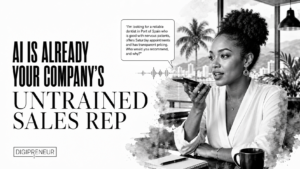
The next visitor to your digital business may therefore not be a human.
It may be software acting on behalf of a human.
That changes what digital readiness means.
Your website now has another audience
For years, businesses were told to make websites mobile-friendly.
Then they had to become search-engine-friendly.
Now they increasingly need to become machine-readable.
An agent evaluating your business needs to understand:
What exactly do you sell?
How much does it cost?
Is it available?
What are the options?
Where do you deliver?
What are the return or cancellation policies?
Can it book?
Can it purchase?
Can it confidently distinguish your offering from a competitor’s?
A beautiful website may still fail in an agentic environment if the important information is hidden inside images, outdated pages, inconsistent listings or poorly structured data.
Businesses need to start thinking about the digital front door differently.
Your future customer may send software through it first.
You control your agent, not theirs
A business needs to decide how its own agent should represent it, including the language, tone and local context it should understand.
If a company deploys its own agent, that agent should not simply be released to behave however it wants.
The business defines the role.
It determines the knowledge sources.
It provides brand guidelines.
It establishes tone.
It determines what the agent can read, draft, send, change or purchase.
It decides when a human must approve an action.
In many ways, configuring an agent resembles onboarding an employee.
But when a customer’s agent interacts with your business, you did not configure that system.
That is precisely why your own digital information needs to be clear, structured and accurate.
There are therefore two agent-readiness questions:
Are we ready to use agents?
And are we ready for everyone else’s agents to use us?
Businesses need an agent-readiness audit
I do not believe companies should rush out tomorrow and automate everything.
That would be irresponsible.
The better starting point is an agent-readiness audit.
Begin by listing the recurring tasks performed across the organisation.
Look for work involving repeated research, monitoring, administration, information retrieval, reporting and software execution.
Then map where the relevant information lives.
Email.
CRM.
Cloud storage.
Calendar.
Accounting.
Payments.
Websites.
Internal databases.
The next step is connection.
Agents become dramatically more useful when they have context. An isolated chatbot knows only what you tell it in the moment. A properly connected system can work across the information that already runs the company.
Then choose one low-risk workflow.
Do not start with moving money or making irreversible decisions.
Start with research.
Monitoring.
Drafting.
Information retrieval.
Administrative preparation.
Let the agent work, review the result and learn where it succeeds and where it requires tighter instructions.
Finally, establish permissions.
What can the agent read?
What can it draft?
What can it create?
What can it send?
What can it change?
What always requires approval?
Agent adoption is not merely a technology decision.
It is increasingly a governance decision.
Connect before you automate
If I had to give businesses one starting principle, it would be this:
Connect before you automate.
Clean up your information.
Centralise your files.
Improve your CRM.
Document your processes.
Make your website structured.
Connect the systems that safely can be connected.
Then begin experimenting with intelligent delegation.
My own experience did not begin with a grand plan to build an AI-powered company.
I connected Gmail.
Then Calendar.
Then Drive.
Then HubSpot.
Then payments.
I began using computer control.
I started scheduling persistent research.
I began allowing AI to search my business context and operate software.
Then one day I realised something had fundamentally changed.
I had created a command centre.
The real question heading into 2027
The most important shift is that we are beginning to separate business capability from human labour hours.
Historically, if a company wanted more output, it generally needed more people working more hours.
Software weakened that relationship.
Automation weakened it further.
Agents could change it significantly.
That does not mean human beings become irrelevant.
It means human beings can increasingly concentrate on the parts of business where judgement, expertise, relationships, creativity and accountability matter most.
For businesses, the opportunity is not simply to replace people.
It is to rethink how work gets done.
For employees, the challenge is not simply to protect today’s task list.
It is to develop the skills required for tomorrow’s.
For solopreneurs, the opportunity may be extraordinary.
Deep expertise combined with a network of digital workers could allow one person to operate with capabilities that historically required a much larger organisation.
And for every business, regardless of whether it ever deploys an internal agent, there is another reality to prepare for.
Your customers will increasingly have agents of their own.
That is why I now believe the question has changed.
It is no longer:
“Are AI agents ready?”
The more useful questions are:
What work are we ready to delegate?
What systems are we ready to connect?
What permissions are we comfortable granting?
What skills do our people need next?
And is our business ready for an economy in which both workers and customers increasingly have AI agents acting on their behalf?
AI agents do not need to run your company tomorrow.
But heading into 2027, businesses should absolutely start learning how to work with them today.