Key Moments
First Grenadian software engineer at Google
Learn how his Google Cloud/YouTube engineering and Google Ads product management path built the expertise behind SpotPay’s mission.Fix the real problem: receiving and using overseas earnings
Understand why cross-border pay isn’t just about transfers—recipients also need a usable way to access, manage, and spend funds.Check US payment rails and card options for your situation
Before signing up, confirm whether your country supports PayPal/ACH/wire transfers and which virtual or physical Visa debit card features are actually available.Verify security approach and costs before choosing SpotPay
Assess how funds are held, how accounts are protected (including stablecoin tech), and confirm limits, transfer times, and fees directly with SpotPay.Zsika Phillip-Baptiste’s journey connects Grenada, Google, Stanford and a question familiar to Caribbean people: how do you receive and use money earned abroad? In this edition of The Digital World on Freedom 106.5 FM, hosts Keron Rose and Curtis Jordan welcome the SpotPay founder and CEO for a conversation about global careers and financial access.
Watch the Zsika Phillip-Baptiste interview
Meet Zsika: a Grenadian journey in global technology
Originally from Grenada, Zsika became the first Grenadian software engineer at Google. He worked as an engineer on Google Cloud and YouTube. Later, he moved into product management in Google Ads. He later earned an MBA from Stanford Graduate School of Business.
Today, he is the founder and CEO of SpotPay, a San Francisco financial technology company with Y Combinator backing. His experience brings together building technology at scale, understanding users and developing a business around a problem he knows personally.
Y Combinator’s company profile confirms his Google background, Stanford MBA and experience growing up between the Caribbean and Latin America. That regional perspective helps explain why moving money across borders became central to his next chapter.
From Google and Stanford to Silicon Valley entrepreneurship
First, the interview introduces the person behind the platform. The conversation’s themes include growing up in Grenada, finding a route into computer science and building a career at one of the world’s largest technology companies.
It also creates room to explore the move from engineering to product management, the decision to pursue Stanford and the relationships that shape a career in Silicon Valley. For Caribbean students and professionals, these themes offer a useful starting point for thinking about skills, mentorship and international opportunities.
At the heart of this part of the interview is a bigger question: what happens when someone takes the experience gained in global technology and applies it to challenges affecting people back home?
SpotPay and the challenge of getting paid from abroad
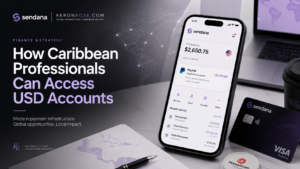
The second half turns to SpotPay’s mission and the practical side of financial access. A remote worker may secure an overseas role, while a freelancer wins an international client. Yet receiving the payment, managing the balance and spending those earnings can still create friction.
Families receiving support from relatives abroad face related questions. The payment experience involves more than sending money: the person receiving it also needs a usable way to access and manage the funds.
SpotPay’s official website describes a digital wallet, local and international transfers, and spending through its Calypso Card. The replay provides the setting for learning more about the company’s approach and the needs it aims to serve.
US accounts, payments and cards: the details to understand
Next, the conversation turns to practical questions for Caribbean users. These include access to US account details, receiving employer or client payments, and whether a particular account and country support PayPal, ACH or wire transfers.
It also covers questions about virtual and physical Visa debit cards: what is available, where users can spend and how they can access their earnings. These are topics to clarify through the replay and SpotPay’s current documentation; they should not be read as a promise that every payment method or card option is available to every user.
Costs and eligibility matter just as much. Before choosing a service, users should confirm supported countries, required identification, transaction limits, transfer times, currency conversion and any account or card charges directly with SpotPay.
Security and the Caribbean’s digital economy
Finally, the security themes include how SpotPay holds funds and protects accounts. They also cover the role of stablecoin technology. Understanding those arrangements helps users assess a financial platform beyond its convenience.
For remote workers, entrepreneurs and families, the wider issue is participation in the global economy. Earning internationally becomes more useful when people can receive, manage and spend their money through tools that fit their circumstances.
Watch the full Zsika Phillip-Baptiste interview above for the conversation with Keron Rose and Curtis Jordan. Explore more conversations in The Digital World, and visit SpotPay’s official website for current product information.
Follow Digipreneur Network on Google
Add us as a preferred source to see more of our technology, digital business and Caribbean digital economy stories in your Google experience.
Add as a preferred source