

Key Moments
Treat the ranking as fit-for-you, not happiness
Use the Top 20 as an editorial shortlist, then adjust for your actual income, work hours, climate tolerance, and need for stability—some lower-ranked places may be better for your specific constraints.Build a portable income before comparing places
Separate take-home recurring income from savings (savings buy time, not permanence) and calculate the real cost of an ordinary month plus move costs before deciding where to live.Match your normal work week to local time
Write your schedule in local time for both peak and off seasons (e.g., Bangkok’s offset changes with US daylight saving) so you don’t accidentally lose evenings and sleep.Verify the exact lawful stay route (not just the visa name)
For each destination, confirm how long stays last, whether renewal/extension is available, and what activities the permit actually allows—many routes are time-limited and case-specific.DIGITAL LIFE / THE 2027 FIELD GUIDE
The best place to live is the place that makes your life work.
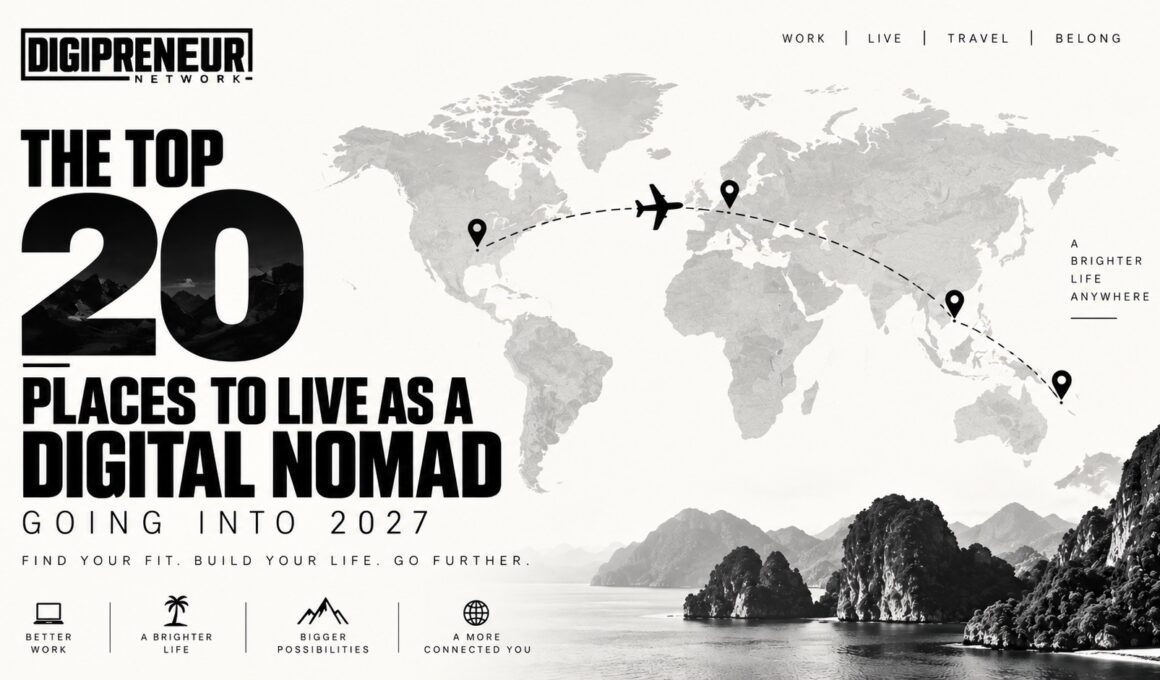
These are 20 of the strongest digital nomad destinations going into 2027. But there is no universally best destination. Your income, working hours, climate preferences and need for stability can make someone else’s favourite city completely wrong for you.
This guide ranks long-term bases, then helps you find your own fit. Think of a home you enjoy returning to, with work that can travel and enough financial room to live well. Constant movement is optional.
By Keron Rose · Research checked 5 October 2026 · 20 ranked bases · 35 destinations in Quick Match
01 / THE EDITORIAL RANKING
The Top 20 digital nomad destinations
Our order reflects a broad editorial assessment of base quality, value, infrastructure, community and lawful long-stay options. It is not a league table of human happiness. Lower-ranked places can be better for you, and several entries require more careful immigration planning.
Budget key: Monthly US-dollar planning allowances for one adult renting a modest private home on a longer lease. These are editorial estimates, not price quotes or visa-income thresholds. See the assumptions and exclusions before using them.
The Top 20 at a glance
- Bangkok · Thailand
- Valencia · Spain
- Kuala Lumpur · Malaysia
- Lisbon · Portugal
- Taipei · Taiwan
- Chiang Mai · Thailand
- Mexico City · Mexico
- Porto · Portugal
- Tallinn · Estonia
- Athens · Greece
- Bali (Canggu / Ubud) · Indonesia
- Málaga · Spain
- Split · Croatia
- Da Nang · Vietnam
- Florianópolis · Brazil
- Medellín · Colombia
- Bansko · Bulgaria
- Funchal · Portugal
- Penang (George Town) · Malaysia
- Grand Baie · Mauritius
Thailand
Bangkok
A connected Asian home base
Best for: Entrepreneurs, creators and people who enjoy a major city.
View full profileClose full profile
Spain
Valencia
A city you can enjoy on foot
Best for: Europe-focused workers who want coast and urban life.
View full profileClose full profile
Malaysia
Kuala Lumpur
Big-city comfort with regional reach
Best for: Remote professionals who value convenience and Asian connectivity.
View full profileClose full profile
Portugal
Lisbon
A mature international network
Best for: Founders and Europe-facing freelancers with room in their budget.
View full profileClose full profile
Taiwan
Taipei
Everyday systems that work for you
Best for: Asia-focused professionals who value transit and convenience.
View full profileClose full profile
Thailand
Chiang Mai
A lower-cost place to focus
Best for: Independent workers who prefer a smaller city and established community.
View full profileClose full profile
Mexico
Mexico City
A major city on an Americas schedule
Best for: Creators, consultants and founders serving the Americas.
View full profileClose full profile
Portugal
Porto
A more compact Portuguese base
Best for: Europe-facing workers who want culture without Lisbon’s scale.
View full profileClose full profile
Estonia
Tallinn
Digital infrastructure with a calmer rhythm
Best for: Technology workers who like compact northern European cities.
View full profileClose full profile
Greece
Athens
Urban energy and Mediterranean access
Best for: Europe-facing workers who enjoy a lively capital.
View full profileClose full profile
Indonesia
Bali (Canggu / Ubud)
A community-rich tropical chapter
Best for: Creators and independent workers who actively want Bali’s social scene.
View full profileClose full profile
Spain
Málaga
A Mediterranean base with international reach
Best for: Europe-facing remote professionals who want coastal city life.
View full profileClose full profile
Croatia
Split
Coastal Europe with a seasonal catch
Best for: Remote workers who want an Adriatic base.
View full profileClose full profile
Vietnam
Da Nang
Excellent lifestyle value; weaker long-term certainty
Best for: Flexible workers exploring a coastal Asian base.
View full profileClose full profile
Brazil
Florianópolis
Outdoor life on an Americas working day
Best for: Remote workers who want beaches and Brazilian city life.
View full profileClose full profile
Colombia
Medellín
Climate and community with meaningful precautions
Best for: Americas-facing workers prepared to plan carefully around security.
View full profileClose full profile
Bulgaria
Bansko
A focused mountain base
Best for: Independent workers who prioritise community and nature over a metropolis.
View full profileClose full profile
Portugal
Funchal
An Atlantic base with a gentler pace
Best for: Europe-facing workers who value nature and a smaller city.
View full profileClose full profile
Malaysia
Penang (George Town)
Food, healthcare and a slower Malaysian rhythm
Best for: Remote professionals who value everyday comfort more than a megacity.
View full profileClose full profile
Mauritius
Grand Baie
A quieter Indian Ocean base
Best for: Established remote workers who want space and a slower pace.
View full profileClose full profile
Attribute labels are our editorial judgements. Internet and healthcare vary by building, provider, insurance and personal needs; they are not measured service guarantees.
02 / KERON’S POINT OF VIEW
Why Thailand is my #1—even if it is not yours
I did not need Thailand to provide my income. I needed it to support the life I wanted to build around income that was already portable.
My Caribbean background makes tropical weather familiar. Meanwhile, 28 years in Canada shaped my appreciation for big-city scale and convenience. Bangkok gives me a combination that fits both parts of my life.
Stability makes a home possible
The five-year DTV gives me a longer planning horizon. I can build a routine, maintain a home and travel without applying for a new Thai visa after every trip. Here is how the stay cycle actually works:
- On entry: the DTV allows a stay of up to 180 days. Check the permitted-until date in your passport stamp.
- Before that stay expires: you can apply to Thai Immigration for one extension of up to another 180 days. Alternatively, leave Thailand and return using your valid DTV for a fresh stay of up to 180 days.
- After the extension: you must leave before the extended permission expires. You cannot keep adding 180-day extensions to the same entry. You can re-enter using the same DTV while it remains valid.
That is one extension per entry, not one extension across the whole five-year visa. Extensions require approval, and each return involves the usual immigration checks. The official DTV page and Thai Embassy’s explanation of the 180 + 180-day cycle set out the framework.
How this fits my life in Bangkok
In practice, this has never been an issue for me during my two years in Bangkok. Travel around Asia is affordable enough that I usually leave Thailand several times before a 180-day stay expires. Those trips are already part of the life I want to live.
Even when I have gone almost six months without travelling abroad, I have had affordable options. My advice is to identify two or three nearby destinations you can comfortably enter on your passport. Know the entry requirements and the total cost of a short visit before you need one.
Then, if I am approaching my stamp’s expiry and have no bigger trip planned, I can take a modest trip to one of those places. I return to my Bangkok home and routine with a fresh DTV entry stamp. Having those options makes the travel requirement manageable for me.
My affordable fallback trips: Phu Quoc and Phnom Penh
Two of my easiest, cheapest options have been Phu Quoc, Vietnam, and Phnom Penh, Cambodia. Phu Quoc is a short flight from Bangkok. On my last trip, my return flight cost about US$110. Phnom Penh return fares have typically been around US$130 in my experience.
Those are my past airfare examples, not current quotes or the full cost of a trip. Accommodation, transfers, food and any visa fees still belong in the budget.
Phu Quoc also has a special visa exemption of up to 30 days for foreign passport holders of all nationalities, subject to entry conditions. For a straightforward island-only visit, fly directly there from outside Vietnam, stay on Phu Quoc and fly directly out internationally. You need at least six months’ passport validity and proof of onward or return travel within the allowed stay.
The island exemption does not automatically let you visit mainland Vietnam. If you want to add another Vietnamese destination, check the visa or exemption you need for that itinerary. Review the Phu Quoc entry conditions with your airline before booking.
Route update, 5 October 2026: Thailand–Cambodia land crossings remain suspended, so Phnom Penh is an air-travel example here. Check the current border guidance before considering a road trip.
My preferred fallback destinations may not be yours. The useful habit is to keep a few accessible, affordable options that work for your passport and budget. For me, that has made Bangkok a stable home base with room to explore the region.
Convenience creates room for better work and life
Bangkok’s digital ecosystem overlaps with my professional interests in commerce, technology and media. Digital payments, delivery services and the surrounding business environment give me things to learn from. In addition, food and everyday services free time for the work and life I actually enjoy.
Regional access adds another layer. Bangkok connects me to other parts of Thailand, Southeast Asia and China. I do not need my home neighbourhood to contain every experience I want. A well-connected base gives me options.
My roughly US$800 baseline is personal
In my account of two years in Thailand, I put my core monthly baseline at about 27,050 baht, approximately US$809 at the conversion used there. It covers my condo, utilities, connectivity and normal food budget.
That figure excludes travel, variable transport, shopping, entertainment, wellness, equipment and business costs. A newcomer also needs to account for insurance, tax, deposits and emergencies. It is not an all-in relocation budget or a promise that your life will cost the same.
The useful lesson is the margin. Portable income and a lower recurring cost base give me more room to build Digipreneur, learn, rest, travel and protect my work-life balance. However, another person could choose the same city and dislike the heat, the pace or the working hours.
03 / BEFORE YOU CHOOSE
Solve these two things first
The destination ranked #1 may be completely wrong for you.
Bangkok can be a strong overall base and a poor choice for someone who works New York office hours, hates humidity and wants a European settlement route. The city has not changed. The person’s requirements have.
1. Build income that can move with you
A remote salary, established business, freelance work, pension or investment income can support a portable life. By contrast, savings serve another purpose: they buy time. If no income replenishes them, every month reduces your remaining options.
Before you compare digital nomad destinations, separate recurring take-home income from your savings. Next, subtract ongoing obligations, realistic living costs and the costs of moving. The result tells you far more than the amount in your account on departure day.
2. Choose for your normal week
Start with what you need and what you cannot tolerate. For example, a beautiful place can still undermine your sleep, concentration or social life. The Quick Match below helps you examine those trade-offs before you fall in love with an address.
EXPERIENCE 01 / QUICK MATCH
Where should
you live next?
Match your work, money and everyday life against 35 destinations. Get your Top 3, one wildcard and the compromises behind each choice.
10 questions · About 2 minutes · No email required
Loading your destination matcher…
The matcher stores answers on this device when browser storage is available. It does not send your answers to our server. Existing site services follow the site privacy policy. Scores describe editorial lifestyle alignment, not visa eligibility or a probability of happiness.
EXPERIENCE 02 / THE DEEP AI ASSESSMENT
Want the serious answer?
The two-minute matcher gives you a starting point. Choosing where to build your life deserves a closer conversation. Pour a coffee and give yourself 15–20 minutes.
Our assessment asks your AI assistant to interview you one question at a time, explain why each answer matters and prepare a personalised Top 5 plus a wildcard. It also tests whether your financial and working arrangements can support the move.
DIGIPRENEUR AI TOOL
Digital nomad
destination assessment
Start fresh, or complete Quick Match to carry your answers into the assessment.
Paste it into a new conversation with your preferred AI assistant. Copying stays on your device. Your answers are shared with that provider only when you paste or send them there.
View the full assessment prompt
If copying is unavailable, select the text above and copy it manually.
YOUR REPORT / ILLUSTRATIVE STRUCTURE
A decision you can explain.
- Readiness: income, runway and the biggest unresolved risk.
- Five ranked bases: personal reasons, budgets and compromises.
- One wildcard: a place your answers justify exploring.
- A practical plan: verified pathways, a trial stay and next steps.
This is a sample report structure, not a personalised recommendation. AI output depends on the model, available research and your answers. Ask it to verify current official sources.
THE FRAMEWORK
How to choose digital nomad destinations that fit your life
Comparing digital nomad destinations works best when you start with the life you need to sustain. Use the following checks to turn a shortlist into a decision.
Income, housing and the cost of an ordinary month
Begin with reliable take-home income after tax and business costs. Then allow for rent, utilities, food, transport, insurance and obligations that stay with you. Short-term furnished housing can cost much more than a local annual lease, especially in tourist seasons.
Next, keep moving costs separate: flights, deposits, document translations, visa fees and initial purchases. Hold an emergency and exit reserve outside your everyday budget. Low monthly rent cannot compensate for a plan that uses all your available cash to arrive.
Formal permission and practical stability
A dedicated nomad visa can help, but its title is not the whole answer. Check which activities it permits, how long each stay lasts, whether renewal is possible and whether you can maintain your home while travelling. Nationality and the source of your income can change eligibility.
Likewise, a destination without a dedicated nomad visa may have another lawful residence route. Popularity alone proves neither permission nor stability. Avoid building a multi-year plan around unverified assumptions about border runs.
Working hours, infrastructure and healthcare
Write your actual meeting schedule in local time for both seasons. Bangkok is 11 or 12 hours ahead of New York depending on US daylight saving. A recurring 9–5 New York schedule can therefore consume the evening and much of the night.
Test internet in the building you intend to rent, not just at a coworking space. Have a backup connection. For healthcare, check the services you personally need, the nearest suitable provider and insurance coverage. General city reputations cannot answer those questions.
Safety, transport and daily-life friction
Think about the precautions a destination asks of you. Would you be comfortable changing how you use your phone, travel at night or meet new people? A safety judgement should reflect your routine and current local advice, rather than a single country score.
Similarly, decide how you want to move. Walking, rail, ride-hailing and scooters produce very different lives. Price the services you would gladly use to make cooking, cleaning or laundry easier. Affordable convenience can give you time, provided the location supports it.
Climate, community and regional optionality
Research the difficult season as carefully as the pleasant one. Heat, humidity, smoke, storms, cold and short winter days can affect health and productivity. A three-week visit may not show you what a full year feels like.
Then ask who you want around you and what the environment adds to your professional life. Founders may value a business ecosystem. Others may prefer a quiet neighbourhood and local relationships. Airport access matters more when you travel often; otherwise, it can be an expensive advantage you rarely use.
Banking, tax and settlement goals
Check how you will receive income, hold money and pay locally. A payment account that works at home may have residency restrictions. Start with our digital business and payments resources, then verify each provider’s rules for your circumstances.
Immigration permission and tax residence are separate matters. Time in a country, personal ties, income sources and treaty rules can all matter. Get advice for your facts before assuming foreign income is tax-free. Someone seeking permanent residence or citizenship also needs a different plan from someone seeking a year abroad.
Let the first months teach you
Your first home does not need to be your forever home. Use a sensible trial period to learn which neighbourhood supports your work, where you exercise and how often you travel. However, make sure the trial itself has a lawful basis for your planned activities.
Once you understand the place, optimise. A cheaper apartment across the city may make your life worse. A slightly more expensive one beside the things you use every day may be better value. The objective is a routine you can maintain and enjoy.
SIDE BY SIDE
Compare your possibilities
Choose two or three destinations. Compare the monthly planning range, everyday infrastructure and immigration caveats side by side. You can add cities from the profiles or explore all 35 below.
Enable JavaScript to use the comparison controls.
BEHIND THE RANKING
Methodology: fit over hype
How we ranked these digital nomad destinations
This is a Digipreneur editorial ranking for people seeking a durable home base with portable income. It is not an official index, a representative survey or a prediction of 2027 rules. We prioritise the combination of lawful stay options, recurring costs, useful infrastructure and the ability to build an ordinary life.
The Top 20 order is editorial judgement. Quick Match performs a separate weighted calculation across 35 destinations. It uses published route information and our explicit 0–5 assessments of everyday attributes. Those assessments are directional, not measured city statistics. A high match score is not a visa approval, safety guarantee or scientifically validated probability.
How the personal calculation works
Your answers change the weights applied to budget, work-hour alignment, environment, transport, community, healthcare, practical stability, airport access and convenience. Climate dealbreakers and a mismatch between your desired stay and the documented route reduce the score. A place outside the Top 20 can rise to first place.
Quick Match does not ask for citizenship, exact tax circumstances or medical history. Therefore, every result still needs an individual eligibility check. A savings-led or developing-income plan receives a readiness note; the tool does not pretend a low cost of living solves uncertain earnings.
What the budgets include
Budget bands are broad October 2026 editorial planning allowances in US dollars. They assume one adult, a modest private apartment on a longer lease outside the most expensive visitor locations, utilities, connectivity, normal food, local transport and modest leisure. However, these figures are not scraped rental quotes or official averages.
They exclude taxes, international flights, deposits, visa and legal fees, business expenses, dependants, major medical costs and individual insurance premiums. Furnished monthly rentals, premium districts and peak seasons can exceed them. Use the upper end plus your personal exclusions when assessing readiness, then get current local quotes.
Sources and their limits
Government immigration and consular sources support the legal-route notes. Bulgaria’s newer route also draws on EY’s immigration update, linked in its profile; confirm implementation with the authorities. Numbeo’s 2026 cost comparison provides a crowdsourced cross-check, not our complete budget or a guarantee of current rents.
Keron’s Thailand account supplies the personal case study. It does not establish what another person will spend. Visa rules, income thresholds, housing costs and local conditions can change before 2027. The source register below records what we checked on 5 October 2026.
RESEARCH / OCTOBER 2026
Sources and last checked date
Open the immigration source register · 20 jurisdictions
- Thailand — DTV · five-year validity; stays are time-limited
- Spain — Formal telework visa / residence pathway
- Malaysia — DE Rantau · up to 12 months + renewal
- Portugal — Formal remote-work residence pathway
- Taiwan — Nomad visitor route; Gold Card is separate
- Mexico — General temporary residence · case-specific
- Estonia — Formal digital nomad D visa
- Greece — Formal digital nomad route
- Indonesia — E33G remote-worker category · eligibility matters
- Croatia — Digital nomad temporary stay · up to 18 months
- Vietnam — Popular base · long-term work route unresolved
- Brazil — Formal digital nomad route
- Colombia — Formal V digital nomad visa
- Bulgaria — Nomad residence route · confirm local process
- Mauritius — Premium Visa · renewable long stay
- Romania — Formal digital nomad long-stay category
- Japan — Six-month nomad stay · no extension
- Germany — Freelance / self-employment route · case-specific
- Malta — Nomad Residence Permit · conditions apply
- Costa Rica — Formal remote-worker stay
Reviewed 5 October 2026. Some underlying official pages were first published earlier; the current available guidance was checked for this draft. Recheck at the time of application.
YOUR NEXT CHAPTER
Build a life you can sustain.
The Top 20 gives you options. Next, the matcher helps you prioritise them. Finally, the deeper assessment asks whether the move makes sense for your actual life.
Build income that can travel. Choose an environment that supports you. Then give yourself enough stability to enjoy being there. That is a more useful goal than simply collecting destinations.
Keep exploring Digital Life, our Careers & Skills coverage and Digipreneur FM.