
Key Moments
Fix ‘remote’ by verifying worldwide eligibility
Don’t trust ‘remote’ labels—extract employer identity, original application page, current status, and the actual location wording to confirm applicants can be worldwide.Use a jobs engine with lifecycle-aware ‘memory’
Track imports, changes, duplicates, expiry, and outcomes so job status and eligibility don’t get lost when postings change or close.Run a feedback loop from imports to engineering improvements
Each import creates evidence trails that the research team analyses, then Astra and ChatGPT Astra-driven tests turn into stronger extraction and rules for future imports.Scale research responsibilities with an AI workforce
Give four Grok Bots recurring, evidence-standard research charters (source scouting, integrity checks, labour intelligence, quality/operations) so quality maintenance doesn’t depend on manual tab-opening.For years, I have heard that there is a limit to what I can build as a solopreneur. I understand the argument. There are only so many hours in a day. But since I started in 2016, the tools available to independent builders have kept changing what those hours can produce.
In October 2026, I decided it was time to put all that research and learning to use and finally build the wider Digipreneur vision I had in mind. It was also the right moment to begin separating the business I want to build from my personal brand.
Digipreneur is where I get to explore the digital economy from multiple angles, each with its own platform and mission. KeronRose.com, meanwhile, is becoming my portfolio: a place to book my services and explore my strategic thinking about building brands and monetising in the digital age.
Digipreneur Network is the media and editorial arm. It brings together the conversations I have across traditional media—TV, newspapers and radio—with exclusive content I create here. Eventually, contributors will be able to add their own perspectives to the topics we discuss.
When I had the idea for Digipreneur Jobs, I could see how it fit with everything else I was building and organising. That connection got me excited enough to start a marathon at the beginning of October. It is only the 19th, and a lot has already taken shape.
I spent long stretches at my computer working on the next stage of Digipreneur Jobs. What emerged was more than a set of AI characters: a custom jobs engine connected to a specialist research team, a shared evidence record and my own decisions in a continuing process.
This is the case study behind the new Digipreneur Jobs AI Workforce: what I built, why I built it, what each team member does and how the system helps me improve both the quality of globally remote opportunities and our understanding of the digital job market.
Start with the problem: “remote” does not mean “worldwide”
Someone looking for work across borders can waste hours on a job labelled “remote” only to discover that applicants must live in one country. Another listing may appear to be a vacancy but actually lead to a general talent pool. A social post may circulate after the employer has closed the role.
For Digipreneur Jobs, the goal is a more useful pool of fully remote opportunities open to applicants worldwide. That requires more than collecting links. We need to know who the employer is, where the original application lives, whether the role is current and what the location wording actually says.
A request to work certain hours or overlap with a timezone is different from a residence restriction. A stated salary needs a currency and pay period. A degree may be required, preferred or absent from the description. The details change whether the opportunity is suitable and how someone should prepare to apply.
The product I built: a jobs engine with memory
Under the public Digipreneur Jobs experience is a custom WordPress jobs engine. It can receive approved source feeds, run scheduled imports, turn incoming records into a consistent format, assess eligibility, handle duplicates, track changes and maintain an operational history. There are also checks for expiry and, where a source supports it, whether a vacancy remains available.
That matters because a job has a lifecycle. It appears, changes, sometimes moves to a new application page and eventually closes. The engine cannot treat the moment of import as the whole story.
1. Finding better sources
Each import gives the engine another chance to identify the original employer and its hiring infrastructure. The system looks for direct employer-board links in permitted feeds and scans retained records in batches for source leads. Those leads still need investigation before they become approved sources.
One useful posting might lead us from a third-party mention to the employer’s own careers page or recruitment feed. That is valuable because a credible direct source can keep providing opportunities long after the first listing disappears.
2. Protecting the quality of the pool
Incoming opportunities pass through rules designed around actual vacancies and worldwide eligibility. The checks distinguish a genuine opening from a speculative application form or talent pool. They also examine geographic wording instead of assuming that a “remote” badge answers the question.
Jobs already on the platform need attention too. The engine can expire records and recheck availability where the source provides a supported method. On direct employer boards, a complete and successful scan can support a closure decision. An incomplete scan is not evidence that every missing job has closed.
That level of care is part of the product. I want someone browsing Digipreneur Jobs to spend more time considering relevant opportunities and less time undoing the mistakes of a noisy feed.
What happens between a feed and a useful job page
To understand the scope of this build, follow one incoming vacancy. The engine first has to reach an approved source and recognise the fields it receives. Different employers and platforms use different formats, so the job is converted into a consistent record before it can be assessed alongside the rest of the catalogue.
Then the eligibility rules examine the evidence. Is this a specific opening? What does the employer say about location? Is a timezone requirement being confused with a country requirement? Has the same opportunity already arrived from another path? The result needs a traceable source and a reason that can be revisited.
After that, the record remains part of an operating system. Scheduled runs can see whether the source changed, whether a job was updated and whether the application route remains useful. The engine keeps a history of imports and outcomes, which means a correction can be investigated as a pattern rather than treated as an isolated mystery.
For a job seeker, much of this work is invisible. That is precisely the point. The public experience should make it easier to assess an opportunity, while the machinery behind it carries the burden of checking, organising and maintaining the information.
3. Learning from each import
Imports create a trail of evidence: which sources produce useful openings, where duplicate or incomplete records appear, how employers phrase location rules and which descriptions challenge our classifications. That evidence tells me where the engine needs stronger extraction, clearer rules or a better source strategy.
When I call the engine self-improving, I mean this continuing cycle. Its scheduled work generates records and source leads. Our research team examines the patterns. I use those findings with ChatGPT Astra to engineer and test improvements. The resulting changes make future imports more useful. The system produces the feedback; we turn that feedback into better technology.
How I build with ChatGPT Astra: my Tony Stark and JARVIS analogy
If I had to explain my working relationship with ChatGPT Astra, I would use Tony Stark and JARVIS. I am not claiming I have built an Iron Man suit. Although, if you know me, you know I would at least sketch one. 😂
My role is to understand the audience and define the product. I decide what counts as an opportunity, where the experience is weak, which evidence I trust and what the platform should accomplish next. I bring real job examples, challenge the results and make the calls about priorities.
Astra is my AI engineering partner. I use it to inspect the code, reason through the architecture, implement changes, investigate unexpected behaviour and test the system against concrete cases. Our work moves between product questions and engineering questions until the software behaves the way the business needs it to.
My question is rarely “Can AI build me a job board?” It is more often “Why did this listing pass? Where did the employer say that? What happens on the next import? Show me the record and the test.”
That distinction matters to me. The value is not one clever prompt. It is the sustained process of turning a vision into source connections, rules, records, interfaces, research routines and tests. I own the direction and the decisions. Astra expands my capacity to build and refine the technology behind them.
What our working process actually looks like
I usually begin with a real friction point: a job labelled “worldwide” that has a hidden country requirement, a source that changes its page structure, or a report that needs a more honest interpretation of salary data. I explain the outcome I want and the standard the result must meet. Then Astra and I inspect the relevant part of the system and the evidence that produced the current behaviour.
Next comes the engineering work. We refine the rule or workflow, preserve the decisions the engine has already recorded and run examples through the revised path. A single change can touch how a source is discovered, how a job is interpreted, how the database remembers it and how an editor sees it. That is why I insist on understanding the whole journey instead of celebrating a change because a button appears to work.
The team makes this process stronger. Their research gives us original links, quotations from employer pages, comparisons across roles and a record of uncertainty. I can ask Astra to use that evidence to improve the technology. Then we check whether the new behaviour helps on the next example and whether it preserves the quality of existing records.
This is how I have learned to scale my thinking as a solopreneur. AI can increase my engineering capacity, but my experience in digital business tells us which problems are worth solving and what a useful result looks like for the audience.
Why the engine needed a team around it
The better the engine became, the more work it created beyond the code. New sources needed investigation. Existing listings needed repeat quality checks. Imported jobs contained information about hiring requirements that could become useful career guidance and industry reporting.
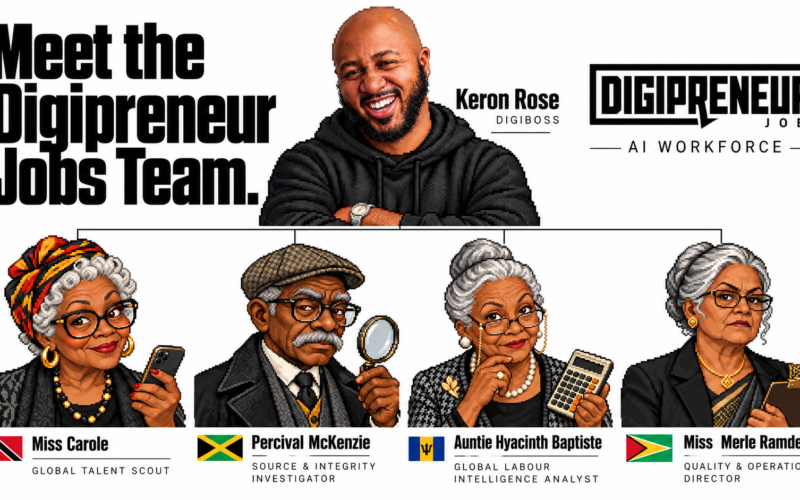
I did not want that work to depend on whether I personally remembered to open five browser tabs each morning. So I gave four recurring responsibilities to specialist Grok Bots, each with an operating charter, evidence standards and a place to record the findings. They are my Caribbean elderstatesmen: colourful personalities with serious jobs.
Meet the Digipreneur Jobs AI Workforce
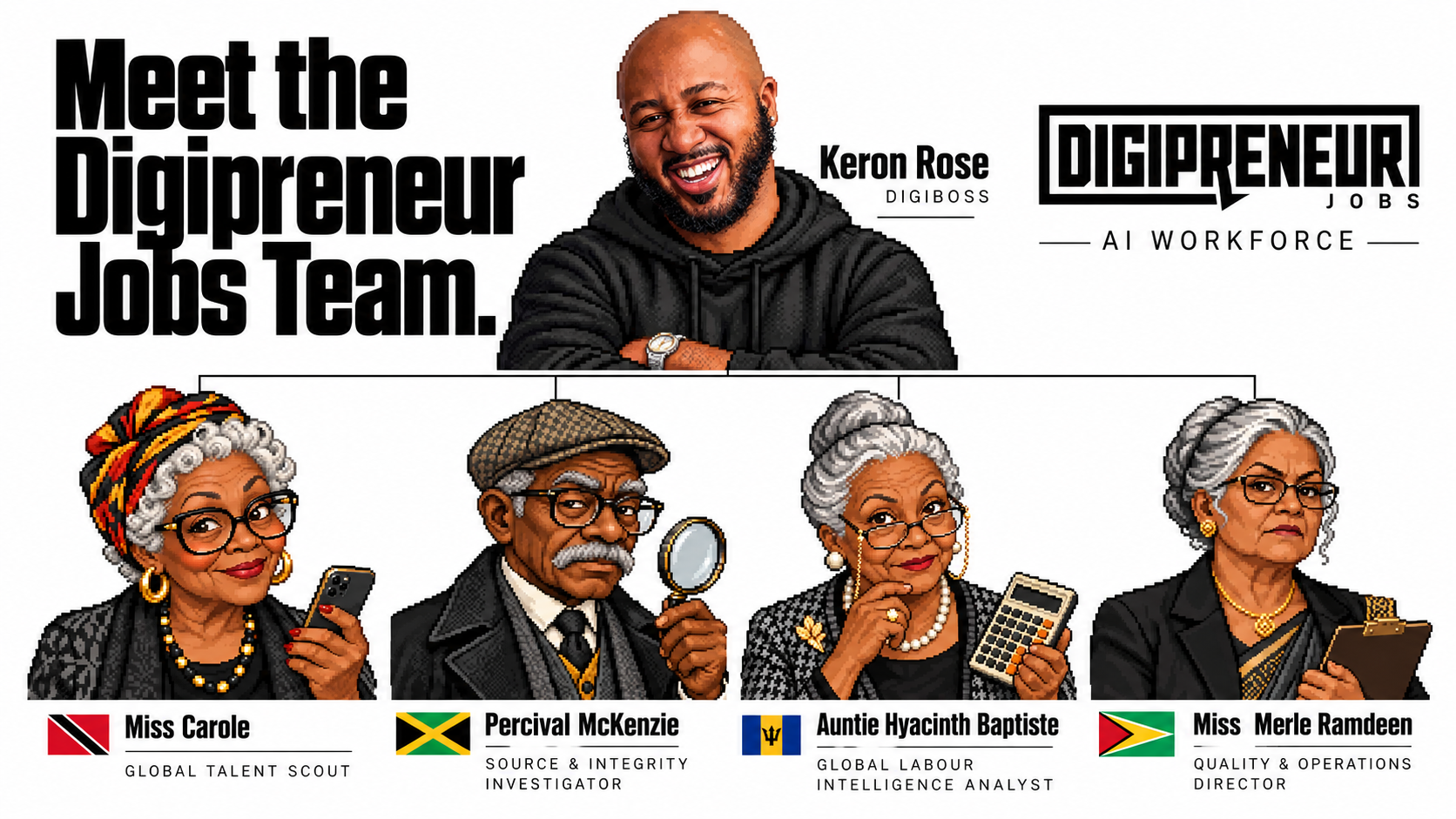

Miss Carole (CNN)
Global Talent ScoutFinds the jobs, the employers and the original feeds worth following.
Carole looks for jobs and for the places jobs come from. She follows public employer sites, recruitment platforms, job boards and social posts, then traces promising leads toward original careers pages and feeds. Her nickname comes from my aunt, whose ability to know who, what, when and why earned her the family title “CNN.”
Her task is especially valuable after an import. A new record may point to an employer we have never tracked directly. Carole investigates whether that employer’s own hiring page could become a continuing source. One good lead can improve the coverage of the entire engine.

Percival McKenzie
Source & Integrity InvestigatorChecks original postings, eligibility and the quality of jobs already in the system.
Percival asks for the original source and the exact wording. He checks whether the employer is real, the vacancy is current, the application route is direct and the location claim is supported. A required timezone overlap does not become a country restriction simply because the two appear in the same sentence.
His responsibilities include reviewing jobs that are already in the system. Does the link still lead to the advertised role? Did the employer change the geographic conditions? Has a duplicate or a general talent pool entered the list? His findings protect the present catalogue and give Astra and me examples that can improve future checks.

Auntie Hyacinth Baptiste
Global Labour Intelligence AnalystTurns verified jobs into evidence about skills, qualifications, pay and hiring trends.
Hyacinth examines what the verified jobs say about work itself. Which skills appear repeatedly? Are degrees required or simply preferred? What certifications, portfolios or assessments do employers mention? When compensation is disclosed, what is the exact range, currency and pay period?
The growing import history gives her more material for careful comparisons across occupations and industries. Combined with our platform’s job views and outbound apply clicks, that research can show what our audience explores and which employers draw attention. Those clicks measure interest on Digipreneur Jobs; they do not tell us how many people applied or prove global demand on their own.

Miss Merle Ramdeen
Quality & Operations DirectorKeeps the evidence, decisions and improvement proposals clear enough to act on.
Merle keeps the research usable. She checks the evidence, flags duplicates, connects findings across the team and consolidates what deserves attention. She also turns recurring issues into specific improvement proposals: the records involved, the pattern she sees and the change we should test.
Her standard is clear: do the work, show the source and explain the decision. The point is to give me a record I can act on, rather than a pile of vaguely promising links.
How the pieces work together
- The WordPress jobs engine imports from approved sources, applies its job rules, maintains records and captures operational signals.
- The Grok Bots research leads, verify provenance, analyse labour-market information and review quality.
- Google Drive holds the team’s research, recommendations, daily briefings and approved decisions so the work can be checked later.
- ChatGPT helps me review the documented findings, decide the next website actions and develop improvements to the engine.
- A scoped MCP connection gives supported AI tools a defined route to specific WordPress research and queue functions.
Imagine I spot a social post with several remote vacancies. Carole identifies the employers and source leads. Percival checks the original postings and eligibility. Hyacinth records the requirements and any explicit pay information. Merle reviews the evidence and consolidates the findings. Their research goes into Drive, and Carole’s scheduled app summary points me back to that record.
At the same time, the engine continues its own scheduled work on approved sources and existing records. When the research identifies a better source, a quality issue or a pattern worth studying, I can bring that evidence to ChatGPT and Astra for the appropriate site action or engineering improvement.
The second product: industry intelligence
The immediate benefit is a stronger job search experience. The longer-term benefit is a growing body of structured observations about the market: what employers are asking for, which qualifications appear in specific fields, how compensation is disclosed and which opportunities attract attention from our audience.
That creates a foundation for Digipreneur Jobs industry reports and career guidance, while giving Digipreneur Network stronger evidence for its wider digital-economy coverage. We can ask better questions: Are AI skills appearing in roles outside software? Where are portfolios taking the place of formal credentials? Which industries state salary ranges openly? What does a sample of globally eligible jobs reveal about the skills people can build now?
The reports will need to state their sample and limits. A dataset drawn from our sources is not the entire global labour market. A missing salary is not a zero salary. Views and clicks on our platform are signals of our audience’s interest, not a count of completed applications. That discipline is what makes the insight useful.
From job listings to questions worth answering
For example, a cluster of communications roles can reveal which employers ask for campaign experience, which ask for media relations, which mention AI tools and which publish a salary. A collection of technology roles can show whether certificates are presented as entry points or extras. A comparison across industries may reveal where employers specify assessments or portfolios.
Those are more useful questions than simply announcing that a sector is “hot.” We can show the underlying job sample, explain what was counted and separate the employer’s requirements from our interpretation. For someone planning a career move, that can translate into a clearer learning plan: which skills to practise, what work to put in a portfolio and which stated requirements deserve attention.
On the product side, the same analysis helps me decide where to invest next. If a field attracts interest but the available listings are weak, we can study more sources. If a source produces many records but few suitable opportunities, we can examine its value. If a classification repeatedly needs correction, that becomes an engineering priority. Each cycle can sharpen both the editorial intelligence and the engine that feeds it.
What this project says about scaling as a solopreneur
Building this has changed the scale of the questions I can ask. I can look at one vacancy, a source feeding hundreds of vacancies, the health of the catalogue and the market patterns emerging across the records. The same system gives me practical work for the team today and better information for the next product decision.
My contribution is still the vision, the judgement and the accountability. Astra helps me engineer the platform. Carole, Percival, Hyacinth and Merle give recurring research responsibilities a home. Together, they let Digipreneur Jobs keep learning from the work it already does.
That is the case study I wanted to share. A solopreneur can build something substantial by understanding the problem deeply, defining good standards and organising modern tools around real responsibilities. In my case, those responsibilities now come with four Caribbean elders and the title “Digiboss.” I can live with that. 😂
Explore the opportunities on Digipreneur Jobs, and tell me: which repeating responsibility in your own business would you turn into a dedicated workflow?